PACS-Enabled Dental Practice Management Platform
Frontend Development • Medical Imaging • Healthcare Platform
Objective
Building a PACS-enabled dental practice management platform
Orachive is a dental practice management platform built at Terahs.ai for dental clinics and hospitals. It brings patient records, dental imaging, treatment information, and clinical workflows into one centralised system. With integrated PACS and DICOM support, it connects each patient’s record with their imaging, so dental professionals can access what they need throughout the patient care journey.
Alongside it, the company was building a medical image annotation platform. In partnership with institutions such as NAAMII and national dental hospitals in Nepal, one of the biggest obstacles was the lack of usable data, and especially of expertly annotated data, for research and AI development. The goal was a system that collects authorised DICOM images from radiology labs, hospitals, and dental clinics, organises them in one place and one format, and lets clinical experts annotate them. This creates the datasets needed to train dental AI models.
My Role
- Frontend Development
- UI Development for Client & Admin Dashboards
- Medical Imaging Integration (OHIF Viewer & Orthanc PACS)
- Annotation System Development
- Product Ideas & Feature Contributions
Process
- Onboarding & Domain Research (dental workflows, DICOM, PACS)
- Frontend Development of the Client-Facing Platform
- Admin Dashboard Development
- Research & Exploration of the OHIF Viewer
- PACS Integration & Viewer Customisation
- Testing Across DICOM Modalities & Datasets
- Iteration Based on Team & Clinical Feedback
Deliverables
- Client-Facing Dental Practice Management Interface
- Admin Dashboard for Managing Forms & Clinical Settings
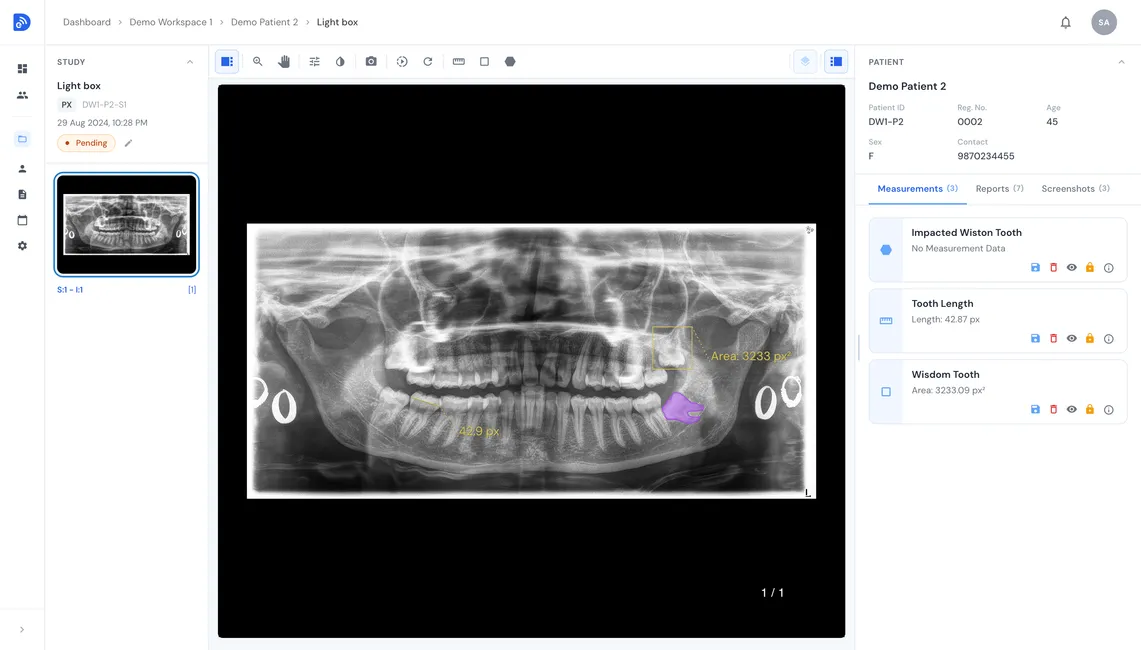
- Web-Based DICOM Annotation Tool
- Customised OHIF Viewer with Tailored Toolbar & Plugins
- Orthanc PACS Integration for Fetching & Storing DICOM Files
- Report Generation & Additional Annotation Tools
Challenges
I joined after ideation and design were complete, so the first challenge was learning an unfamiliar domain quickly: dental clinical workflows, DICOM, PACS, and how medical imaging is processed on the backend. The bigger technical challenge was the OHIF Viewer. It is a large, complex open-source tool, and our system needed only part of it plus features it didn’t have. Making it fit meant going deep into its plugin system, configuration, and source code, with little documentation for what we were trying to do.
Approach
- Domain Learning: Studied the system’s purpose, clinical workflows, and long-term goals, which let me move beyond implementation and contribute ideas to improve the product for clinics.
- Practice Management Platform: Built the client-facing interface for doctors and an admin dashboard where administrators manage forms and settings used on the clinical side.
- OHIF Viewer Integration: Taught myself the OHIF Viewer and engaged with its open-source community to solve integration problems.
- Customisation: Reverse-engineered parts of OHIF’s libraries and source code to keep only the tools we needed, customise the toolbar, and inject custom annotation logic and new tools such as report generation.
- PACS Integration: Connected the viewer to an Orthanc PACS server so DICOM files are fetched and stored dynamically, viewable and annotatable directly in the browser.
- Annotation Workflow: Built a React and Material UI interface designed to make annotation fast and intuitive for clinicians.
- Compatibility: Ensured the tool worked across multiple DICOM modalities and datasets.
- Impact: Reduced manual image handling, improved annotation speed by 40%, and laid a scalable foundation for future medical imaging work.
Reflections
This project took me well outside my comfort zone. I went from implementing designs to understanding a specialised medical domain deeply enough to shape how the product should work. Learning a large open-source tool from its source code, rather than from tutorials, changed how I approach unfamiliar technology.
- Learning a complex domain (medical imaging, DICOM, PACS) from the ground up
- Navigating and customising a large open-source codebase
- Using community resources to solve problems with little documentation
- Growing from a frontend role into contributing product ideas